

Call Us
You may see traditional daycare centres, Montessori schools, Montessori-inspired childcare centres, and programs that combine several early learning philosophies. With so many options, it is reasonable to wonder what actually makes a daycare Montessori and what your child would experience there each day.
A Montessori daycare incorporates principles from the Montessori method of education, an approach developed by Dr. Maria Montessori. At its core, the approach views children as active participants in their own learning. Children are given developmentally appropriate opportunities to explore, make choices, work with hands-on materials, practise everyday skills, and become increasingly independent.
That doesn't mean children are simply left to choose whatever they want throughout the day. Montessori environments are intentionally organized, and educators provide structure, routines, guidance, and appropriate boundaries.
The greatest gifts we can give our children are the roots of responsibility and the wings of independence.
Maria Montessori Tweet
For parents, understanding how these principles translate into everyday childcare can make it easier to decide whether Montessori daycare is a good fit for their child.
The term “daycare” describes a childcare setting, while Montessori describes an educational philosophy or approach. For this reason, the difference between a Montessori daycare and another daycare is often found in how children experience their day and how learning opportunities are organized.
In a more educator-directed environment, the whole group may be expected to participate in the same activity at the same time. In a Montessori-influenced environment, children may have more opportunities to select from appropriate activities and spend time working with them independently.
The educator remains an important part of the process but may act more as an observer and guide rather than directing every moment.
A child might choose an activity involving sorting, pouring, matching, counting, building, language, or practical life skills. The educator can demonstrate how an activity works, observe the child’s progress, and provide assistance when necessary.
This approach gives children opportunities to develop skills through experience rather than relying entirely on direct instruction.
One of the central ideas behind the Montessori method of education is that children learn through interaction with their environment.
For young children, learning is not limited to sitting down and receiving information from an adult. They learn by touching, moving, experimenting, repeating, communicating, observing, and solving problems.
Consider something as simple as pouring water from one small container into another.
For an adult, it is an everyday task. For a young child, it can involve concentration, coordination, fine motor control, sequencing, responsibility, and independence.
Other activities might involve:
These experiences can help children practise skills while giving them a sense of purpose and accomplishment.
Montessori learning is often hands-on and purposeful.
Instead of presenting children with an activity only to keep them occupied, materials and experiences are selected with developmental learning opportunities in mind.
A Montessori environment may include areas dedicated to practical life, sensory exploration, language, mathematics, and other developmentally appropriate activities.
Children may also have opportunities to repeat an activity.
Repetition is important during early childhood. A child who completes the same activity several times may be strengthening concentration, coordination, memory, confidence, or understanding.
Parents shouldn’t necessarily expect every child in the room to be doing the same thing at the same time.
One child might be deeply engaged with a practical life activity while another is exploring early mathematical concepts. The Montessori teaching approach allows educators to observe children’s interests and developmental progress and introduce appropriate experiences.
The physical environment is an important part of Montessori education.
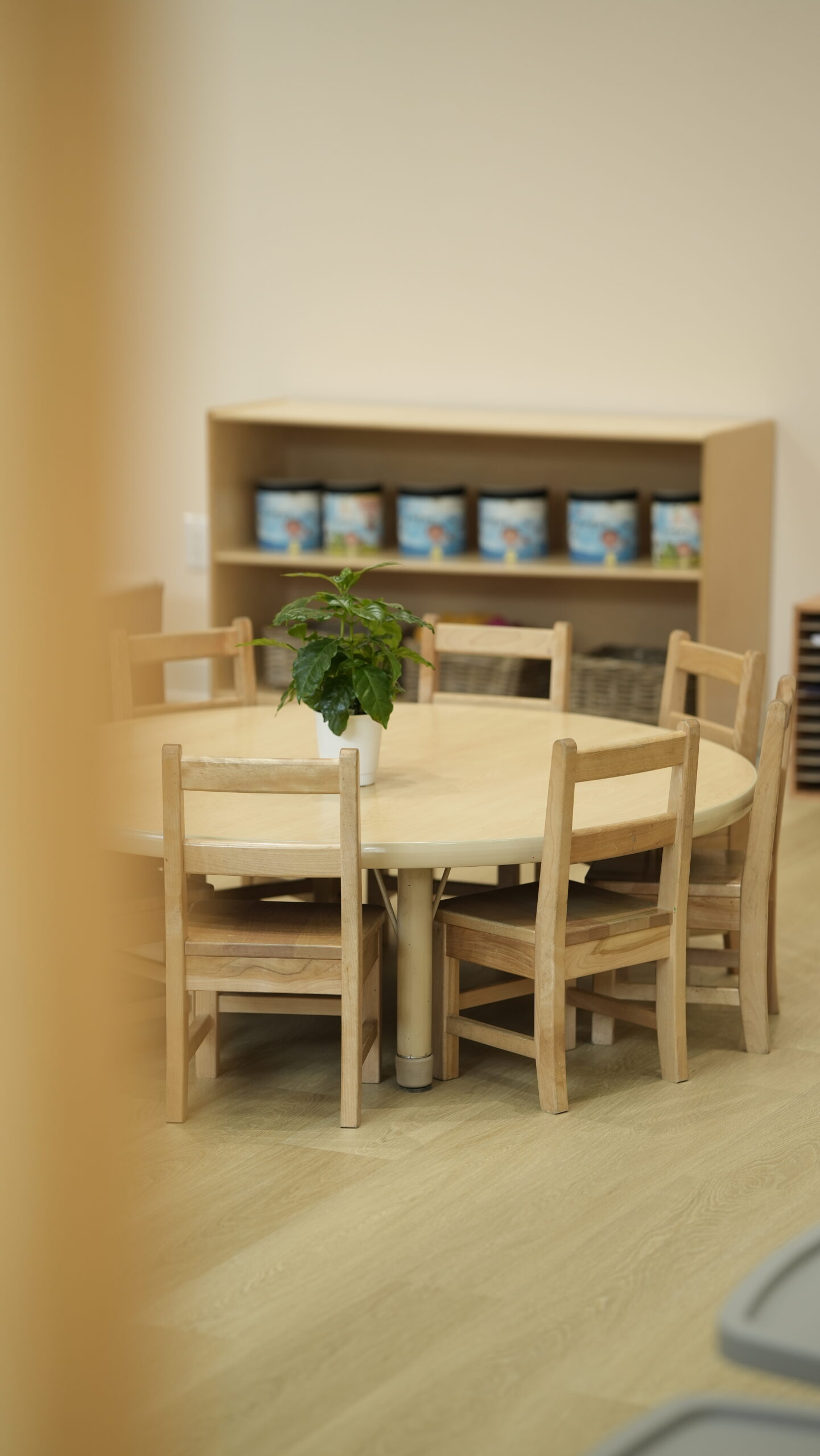
You may hear the term prepared environment when researching Montessori daycare. This means the space has been intentionally organized to support children’s learning and growing independence.
A Montessori-influenced classroom may include:
Materials are generally placed where children can access them appropriately rather than having everything controlled by adults.
Organization also has a developmental purpose.
When children learn where an activity belongs, take it from the shelf, use it, and return it when finished, they are practising responsibility and independence as part of the learning experience.
Independence is one of the most recognizable characteristics of Montessori education.
However, it is important for parents to understand what independence means in early childhood.
It does not mean expecting toddlers or preschoolers to function without adult support.
Instead, educators create age-appropriate opportunities for children to try things themselves.
A child may gradually learn to:
An educator is still available when the child needs assistance.
The difference is that the adult doesn’t automatically complete every task for the child.
Over time, small experiences of success can help children develop a sense of capability and confidence.
The educator plays an important role in the Montessori teaching approach, but that role may look different from a highly teacher-directed classroom.
Educators observe children, introduce activities, model how materials are used, maintain the learning environment, establish boundaries, and provide support.
They also need to recognize when to help and when to give a child more time to try independently.
For example, if a child is struggling with an activity, an educator might demonstrate one step rather than immediately completing the entire task.
This gives the child another opportunity to solve the problem.
When visiting a Montessori daycare, parents should pay attention to these interactions.
Look at whether educators speak respectfully to children, respond when children need emotional support, encourage appropriate independence, and create an environment where children appear comfortable asking for help.
Every daycare has its own schedule, so parents should ask each centre about its specific routine.
A typical day may include a combination of:
The balance between these experiences can vary considerably between Montessori daycare programs.
This is one reason parents should look beyond the Montessori name when comparing centres.
Ask to see a typical daily schedule and find out how much time children have for hands-on activities, outdoor experiences, creative exploration, meals, rest, and social interaction.
No. A quality early childhood program should consider much more than early academics.
Children are developing physically, socially, emotionally, cognitively, and creatively at the same time.
Montessori activities can support early language and mathematics, but they may also help children practise:
For example, preparing a simple snack isn’t a conventional academic lesson, but it can involve following steps, motor coordination, responsibility, concentration, and practical independence.
Likewise, caring for a classroom plant may encourage observation, responsibility, and an understanding of the natural environment.
This distinction is especially important when parents search for a Montessori daycare near me.
Not every centre influenced by Montessori operates as a traditional Montessori school.
A Montessori-inspired daycare may incorporate important Montessori principles while also using other early childhood approaches.
These may include:
The centre might combine these principles with play-based learning, Reggio Emilia-inspired practices, outdoor education, creative activities, music, science, or other experiences.
Neither the label “Montessori” nor “Montessori-inspired” tells parents everything they need to know.
Ask the centre to explain exactly how its educational philosophy influences children’s everyday experiences.
Montessori principles can be adapted to different stages of early childhood.
For toddlers, activities may emphasize movement, language, sensory exploration, simple practical life skills, routines, and growing independence.
As children become older, they may participate in increasingly complex language, mathematics, practical life, problem-solving, creative, and social experiences.
The important consideration is whether activities are appropriate for the child’s developmental stage.
Parents should therefore ask how the daycare adapts its program for different age groups rather than assuming the same activities are used with every child.
Typing Montessori daycare near me or Montessori day care near me into Google can give you a list of nearby options, but location should only be the beginning of your research.
Once you create a shortlist, consider:
Most importantly, visit the centre whenever possible.
A website can explain an educational philosophy, but a tour allows you to see how that philosophy is actually being applied.
Observe the classroom. Look at the materials. Watch how educators communicate with children. Ask questions about the daily routine and consider whether you can imagine your child feeling comfortable in the environment.
If you are comparing preschool options as well as daycare, our complete guide to finding a Montessori preschool near you explains how parents can evaluate curriculum, educators, learning environments, licensing, tours, and other important factors before choosing a program for their child.
A Montessori daycare can provide much more than supervision while parents are working. When thoughtfully implemented, Montessori principles can create opportunities for children to explore, practise everyday skills, develop independence, communicate, solve problems, and become increasingly confident in their abilities.
But the Montessori name should never be the only reason you choose a childcare centre.
Look at the complete experience.
Consider the educators, safety, classroom environment, daily routine, outdoor opportunities, communication, meals, location, and how the program responds to your child’s individual needs.
Ask how Montessori is incorporated into the program and whether the centre follows a traditional Montessori model or uses a Montessori-inspired approach alongside other early learning philosophies.
Ultimately, the right daycare is one where your child can feel safe, supported, connected, curious, and excited to learn.