

Call Us
Beyond the recognizable learning materials and carefully organized classrooms, many of the most important Montessori benefits relate to how children learn to participate in their environment, make choices, solve problems, practise everyday skills, and gradually become more independent.
Montessori education was developed around the idea that children are active participants in their own development. Instead of expecting every child to complete exactly the same activity at the same time, Montessori environments provide developmentally appropriate experiences that children can explore with guidance from educators.
For preschool-aged children, this can mean opportunities to develop concentration, independence, coordination, language, early mathematical understanding, social skills, problem-solving abilities, and confidence through purposeful hands-on experiences.
However, parents should also understand that Montessori is not a guarantee of any particular outcome. Children are individuals, programs vary, and the quality of the educators and learning environment matters.
The greatest gifts we can give our children are the roots of responsibility and the wings of independence.
Maria Montessori Tweet
So what are the potential benefits of Montessori education, particularly during the preschool years?
One of the most recognizable Montessori benefits is the emphasis on independence.
In many early childhood environments, adults naturally want to help children. Sometimes, however, helping too quickly can remove opportunities for children to discover what they are capable of doing themselves.
Montessori environments are designed differently.
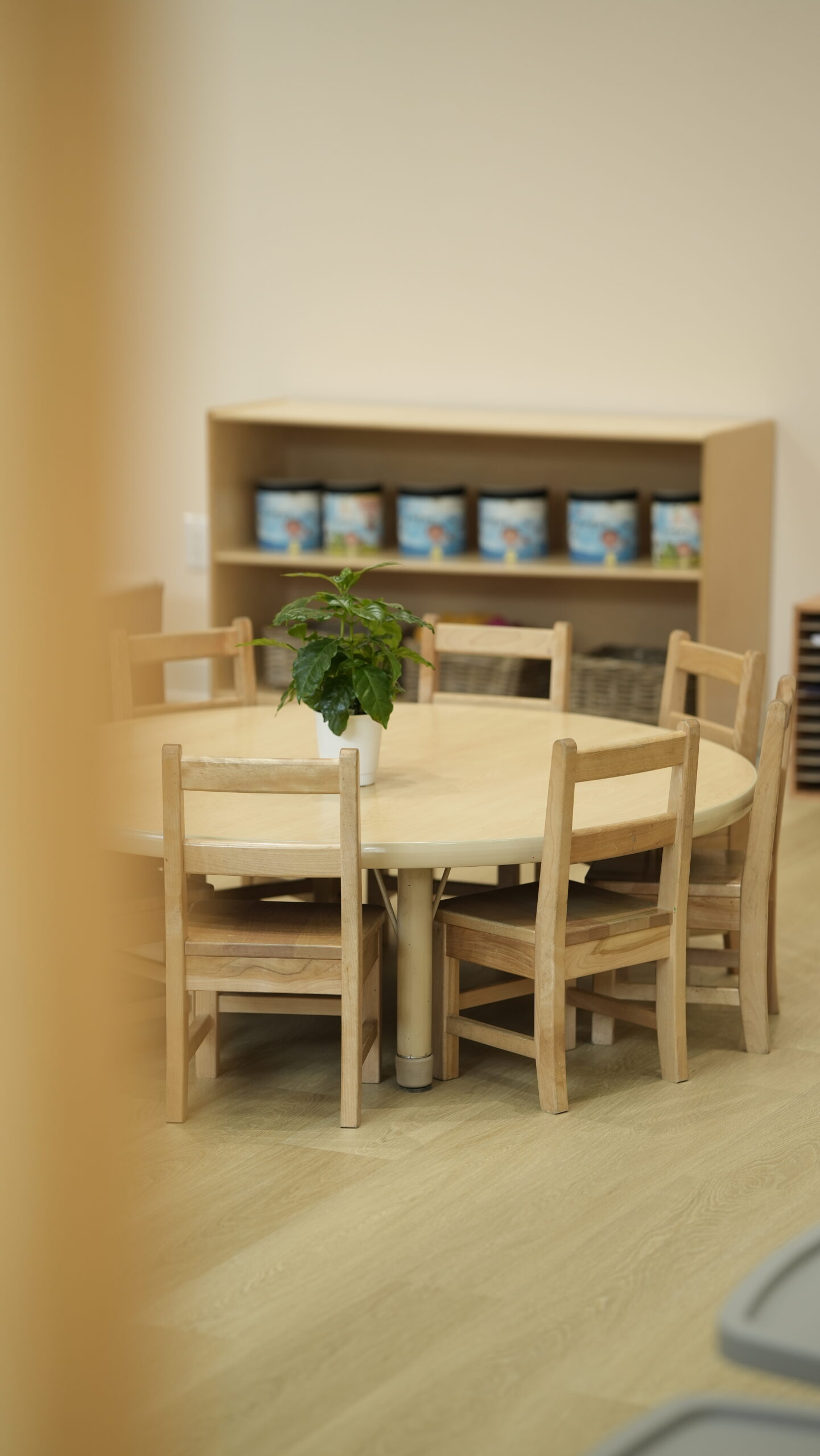
Furniture, materials, activities, and routines are often arranged so children can participate more independently.
A preschool child might practise:
These may appear to be small everyday tasks, but for a young child they can provide meaningful opportunities to practise coordination, sequencing, concentration, responsibility, and self-confidence.
The objective isn’t to make children independent before they are developmentally ready.
Educators still provide guidance and assistance.
Instead, children are given appropriate opportunities to try.
Over time, repeatedly experiencing “I can do this myself” can contribute to a growing sense of capability.
Young children are naturally curious, but developing the ability to remain engaged with an activity takes practice.
Montessori environments can provide opportunities for sustained attention by allowing children to select appropriate activities, work with them, repeat them, and finish at their own pace.
A child might repeat a pouring activity several times.
Another might spend considerable time arranging objects according to size.
Another may become absorbed in counting, drawing, building vocabulary, or working with a sensorial material.
Instead of interrupting simply because a predetermined activity period has ended, Montessori learning can provide children with opportunities to remain engaged when meaningful concentration is occurring.
This doesn’t mean preschoolers are expected to sit quietly for hours.
Movement is an important part of early childhood.
Rather, children gradually practise focusing their attention on purposeful activities.
Research on Montessori education has examined outcomes including executive function. A 2023 systematic review found an overall positive effect across academic and nonacademic outcomes, including moderate-quality evidence for executive function, although outcomes and evidence quality varied across domains.
For parents, the important takeaway is not that Montessori automatically produces exceptional concentration. It is that the environment intentionally creates opportunities for children to practise concentration and self-directed engagement.
Another important feature of Montessori education is its use of hands-on experiences.
Preschool children are still developing their understanding of abstract concepts.
Being told that the number five represents a quantity is different from physically interacting with five objects.
Montessori learning materials can allow children to see, touch, move, arrange, compare, count, sort, and manipulate information.
This can be particularly useful in areas such as:
Children can encounter a concept concretely before being expected to understand it only as a symbol or abstract idea.
For example, early mathematical activities may help a child physically experience quantities before connecting those quantities with written numerals.
If you’d like to explore these learning areas in more detail, our guide to what children learn in a Montessori curriculum explains practical life, sensorial learning, language, mathematics, creativity, social-emotional development, and other curriculum areas.
Practical life is one of the areas that makes Montessori particularly distinctive.
Children are given opportunities to participate in activities connected to everyday life rather than being separated from them.
Depending on age and development, practical life experiences may involve:
These activities have multiple purposes.
Pouring water, for example, isn’t simply about learning to pour.
The child may also be practising hand-eye coordination, fine motor control, concentration, sequencing, careful movement, and independence.
Practical activities can also help children understand that they are contributing members of their environment.
Rather than adults doing everything for them, children can participate appropriately in everyday routines.
Preschool children use their hands constantly as they develop.
Skills involving fingers, hands, wrists, and hand-eye coordination eventually contribute to activities such as drawing, dressing, eating independently, manipulating tools, and writing.
Many Montessori activities naturally involve controlled movements.
A child might:
Because these movements occur within purposeful activities, fine motor practice becomes integrated into the child’s everyday learning rather than existing only as a separate exercise.
Children do not all develop exactly the same skills at exactly the same time.
One preschooler may be fascinated by numbers while another is deeply interested in language. Another might spend considerable time developing practical skills or exploring sensory materials.
An important aspect of Montessori learning is that children can have opportunities to progress according to their development rather than being required to move through every experience at precisely the same pace as everyone else.
The educator still plays an important role.
Educators observe children, introduce suitable activities, and help them progress toward new challenges.
But learning isn’t necessarily built around having the entire class complete the same task simultaneously.
This can give children time to practise skills that are challenging and move forward when they are ready for something more complex.
Confidence in early childhood doesn’t have to come primarily from adults repeatedly telling children they are doing a great job.
It can also develop from genuine experiences of capability.
Consider the difference between an adult saying:
“You’re such a big kid!”
and a child independently completing something that was previously difficult.
Successfully putting on a coat, completing an activity, carrying a glass without spilling it, solving a problem, or remembering where something belongs provides concrete evidence of growing capability.
Montessori environments intentionally provide many opportunities for this kind of experience.
Children encounter manageable challenges, receive guidance when needed, practise, make mistakes, and try again.
The resulting confidence can come from accomplishment rather than praise alone.
Not every difficulty needs to be solved immediately by an adult.
When a child encounters a manageable problem, having an opportunity to think about what to do next can be valuable.
Perhaps something doesn’t fit.
Perhaps the child has forgotten the next step.
Perhaps an activity doesn’t produce the expected result.
Educators can provide appropriate support without automatically supplying the solution.
This allows children to experiment, observe, adjust, and try again.
Some Montessori materials are also designed in ways that allow children to notice errors through the activity itself rather than relying entirely on an adult to tell them whether they are correct.
That changes the learning experience from:
“Did the teacher say I was right?”
toward:
“Does this work? What could I try differently?”
Montessori education doesn’t focus only on independence and practical skills.
Language and mathematics are also important parts of the curriculum.
Language experiences can involve vocabulary, conversations, sounds, letters, writing preparation, storytelling, books, and eventually reading and writing according to children’s developmental readiness.
Mathematics can begin with concrete experiences involving quantity, counting, sequencing, patterns, comparison, numerals, and mathematical relationships.
The hands-on nature of Montessori materials can help make these concepts more tangible for young children.
A 2023 systematic review found positive effects for Montessori education overall and reported high-quality evidence for positive effects in language and mathematics, though effect sizes were modest and varied across outcomes.
A more recent randomized study of public Montessori preschool also reported higher reading, short-term memory, theory-of-mind and executive-function scores by the end of kindergarten among children offered Montessori placements, while noting limitations and finding no notable effects at earlier preschool measurement points.
This is why it’s better to say research provides encouraging evidence rather than claiming Montessori is universally superior.
Independence does not mean isolation.
Children in Montessori environments are still part of a social community.
They interact with other children, observe peers, communicate, share spaces and materials, practise courtesy, experience disagreements, and develop relationships.
Mixed-age environments are also traditionally associated with Montessori education.
Younger children may observe older children doing things they have not yet mastered, while older children can have opportunities to model skills and responsibility.
Social development can also occur through everyday routines.
Children learn that materials belong to a community.
They learn to wait when another child is using something.
They learn that their actions affect other people.
They practise communicating needs and navigating disagreements.
These are important parts of early childhood development regardless of educational philosophy.
Montessori environments often invite children to participate in caring for the spaces they use.
That may involve:
These routines can help children understand that maintaining an environment isn’t exclusively an adult responsibility.
They participate in the community around them.
This can support responsibility while also reinforcing practical skills and independence.
When parents hear “kindergarten readiness,” they sometimes immediately think about reading, writing, and numbers.
Those skills matter, but readiness involves much more.
A child entering kindergarten may also benefit from being able to:
Many of the Montessori benefits discussed throughout this article can contribute to these broader readiness skills.
The objective should not be to make preschool into elementary school early.
Preschool can instead help children develop the foundations they need to approach their next learning environment with curiosity and confidence.
No.
This is an important qualification.
A philosophy alone cannot guarantee a child’s experience.
The quality of the educators, implementation of the approach, classroom environment, relationships, individual child’s needs, family circumstances, and many other factors can influence outcomes.
Research also doesn’t show identical results across every study.
For example, a randomized French study of an adapted Montessori curriculum found outcomes comparable to conventional education in mathematics, executive function and social skills, while finding stronger reading outcomes for the Montessori group.
That is why parents should be cautious about marketing claims suggesting Montessori will automatically make a child smarter, more independent, more creative, or more academically successful.
The better question is:
Does this particular program provide high-quality experiences that fit my child?
At Child Connect Early Learning, Montessori principles contribute to an approach that also draws from Reggio Emilia and purposeful play.
Children have opportunities to develop through hands-on experiences, independence, creativity, social interaction, communication, practical activities, outdoor learning, and exploration.
Parents interested in seeing how these learning areas fit together can explore our curriculum.
You can also learn about our preschool program and the experiences available to preschool-aged children.
Families looking for childcare on the North Shore can explore our West Vancouver centre.
If you’re still researching local Montessori options, our complete guide to finding a Montessori preschool near you explains what parents should consider when comparing programs.
And when you’re ready to experience the learning environment firsthand, you can book a tour.
The potential Montessori benefits extend beyond learning numbers, letters, or completing specific classroom activities.
The approach can give preschool children opportunities to develop independence, concentration, practical skills, coordination, confidence, problem-solving abilities, social awareness, and responsibility while building foundations in language, mathematics, creativity, and other areas of learning.
Research on Montessori education is encouraging, but parents should avoid interpreting it as a guarantee that Montessori will be better for every child or that every Montessori-labelled program provides the same experience.
The quality of the actual environment matters.
The educators matter.
And most importantly, the individual child matters.
Understanding the potential benefits can help parents decide whether Montessori deserves a place on their shortlist. The next question is more personal: is Montessori actually worth it for your child and family?