

Call Us
The Montessori curriculum takes a broad approach to early learning, combining practical skills, sensory experiences, language, early mathematics, social development, independence, creativity, and exploration.
Rather than focusing only on traditional academic instruction, Montessori learning gives children opportunities to develop through purposeful, hands-on experiences. Children may work independently, interact with classmates, explore carefully selected materials, practise everyday tasks, and gradually take more responsibility for themselves and their environment.
For parents, understanding the curriculum of Montessori education can make it easier to decide whether this type of preschool environment fits their child's personality, interests, and developmental needs.
The greatest gifts we can give our children are the roots of responsibility and the wings of independence.
Maria Montessori Tweet
While individual Montessori programs can differ, several core areas are commonly associated with Montessori education for preschool-aged children. If you’re also wondering how these principles work in a childcare setting throughout the day, learn what Montessori daycare is and how it works.
The Montessori curriculum is designed around the developmental needs of children rather than simply dividing the day into conventional academic subjects.
In a Montessori environment for children around ages three to six, learning commonly includes practical life, sensorial experiences, language, mathematics, and broader exploration of areas such as science, geography, music, and art. The Association Montessori Internationale describes the 3–6 environment as one in which children learn through real-life activities, concrete sensory experiences, exploration, and opportunities to work at their own pace.
This means a preschooler’s day may look quite different from a classroom where every child completes the same worksheet or activity simultaneously.
An educator may introduce a material or activity and then allow the child to practise it. Children can develop concentration through repetition and gradually progress toward more complex experiences.
The goal is not simply to teach children information. It is also to help them develop the skills and confidence they need to become active learners.
Practical life is one of the most recognizable areas of Montessori learning.
These are purposeful activities connected with everyday life. Depending on the child’s age and the preschool environment, they may include:
At first glance, pouring water or cleaning a table may not look like traditional education. However, these activities can involve concentration, coordination, sequencing, fine motor control, responsibility, and independence.
The Association Montessori Internationale describes practical life activities as experiences that can help children develop independence and social skills.
There is also an important emotional component.
When a child successfully completes a real task without an adult immediately taking over, the child has an opportunity to experience:
“I can do this.”
Those small experiences can gradually contribute to confidence and independence.
Young children gather information through their senses.
The sensorial area of the Montessori preschool curriculum gives children opportunities to explore characteristics such as:
A child might arrange objects according to size, match colours, compare shapes, identify differences between textures, or organize materials according to specific characteristics.
These activities can help children practise observation, comparison, classification, sequencing, and problem-solving.
Sensorial learning can also create foundations for later concepts.
For example, recognizing differences in dimensions and quantities can contribute to mathematical understanding, while careful listening can support aspects of language development.
Montessori materials frequently move learning from a concrete experience toward a more abstract understanding, allowing young children to interact physically with a concept before encountering it primarily as a symbol or idea.
Language is not limited to a single lesson.
Children develop communication skills through conversations with educators, interactions with classmates, stories, songs, books, vocabulary activities, sounds, and opportunities to express their ideas.
Depending on the child’s developmental stage, Montessori language experiences may involve:
The environment itself can encourage communication.
Educators model language, introduce vocabulary, listen to children, and provide opportunities for children to express what they see, think, need, and feel.
Children develop at different rates, so the objective should not be to make every preschooler read or write at exactly the same age.
Instead, a rich language environment provides foundations that children can build on as their skills develop.
The Montessori curriculum is particularly well known for its hands-on approach to mathematics.
For a young child, a written number can be very abstract.
Montessori learning can introduce mathematical concepts through objects children can see, touch, move, compare, count, and organize.
Early mathematical experiences may involve:
A child can first experience what a quantity represents and gradually connect that experience with a numerical symbol.
AMI describes Montessori mathematics materials as supporting children’s understanding of quantity and mathematical concepts through concrete materials and sequential experiences.
This hands-on progression can help make abstract concepts more meaningful for young learners.
Fine motor development is important during the preschool years because children increasingly use their hands for activities such as drawing, dressing, eating, building, manipulating objects, and eventually writing.
Many Montessori activities naturally involve controlled hand and finger movements.
Children may practise:
Instead of always separating fine motor development into a specific exercise, the Montessori teaching approach often incorporates these movements into meaningful activities.
For example, transferring objects with a small tool can require concentration and hand-eye coordination while also giving the child a clear purpose for the activity.
Preschool isn’t only about preparing children academically.
Children are also learning how to live and participate within a community.
During their day, they encounter opportunities to:
Montessori environments traditionally include an emphasis on respect for other people, classroom materials, and the shared environment.
Children still experience disagreements and difficult emotions. These are normal parts of early childhood.
The educator’s role is not to eliminate every challenge but to help children develop the language, confidence, and social skills needed to handle increasingly complex situations.
Independence is woven through many areas of the curriculum of Montessori education.
Children may be encouraged to choose an appropriate activity, carry it to a workspace, complete it, and return the materials when finished.
They may also participate in everyday responsibilities such as putting away belongings, preparing food, cleaning a small spill, or caring for classroom materials.
This does not mean educators stop helping children.
Instead, children receive support while still being given appropriate opportunities to try.
An adult might demonstrate how to complete a task and then allow the child to practise rather than immediately stepping in whenever something becomes difficult.
Over time, these experiences can help children develop greater confidence in their own abilities.
Some parents assume that Montessori education is highly structured and therefore leaves little room for creativity.
The reality is more nuanced.
Creativity does not have to mean that every child participates in the same craft project and produces an identical result.
Children can express creativity through:
AMI notes that Montessori environments can include opportunities for art, music, movement, language, mathematics, and sensory exploration while allowing children room for individual expression.
Montessori-inspired preschools may also combine Montessori principles with other educational approaches, creating additional opportunities for creative and collaborative learning.
A preschool curriculum should not be evaluated only by what happens inside the classroom.
Young children also benefit from opportunities to move, explore, observe, interact, and experience the natural world.
Depending on the preschool, outdoor learning may involve:
These experiences can connect naturally with practical life, science, sensory exploration, physical development, and social learning.
British Columbia’s Early Learning Framework also presents early learning as a holistic process involving relationships between children, adults, ideas, materials, places, and histories.
For parents comparing Montessori programs, it is worth asking how much time children spend outdoors and whether outdoor experiences are treated as meaningful parts of learning.
Parents naturally want preschool to help prepare their children for kindergarten.
However, kindergarten readiness involves much more than knowing the alphabet or being able to count.
Children entering kindergarten can benefit from developing abilities such as:
Academic foundations in language and mathematics are valuable, but social, emotional, physical, and practical skills are also important.
A thoughtful Montessori education preschool environment can provide children with opportunities to practise many of these skills naturally throughout their day.
The goal should not be to turn preschool into kindergarten early.
Instead, children can gradually develop the confidence, curiosity, communication, independence, and learning habits that support their transition into the next stage of education.
Not every preschool that uses Montessori terminology will implement the philosophy in exactly the same way.
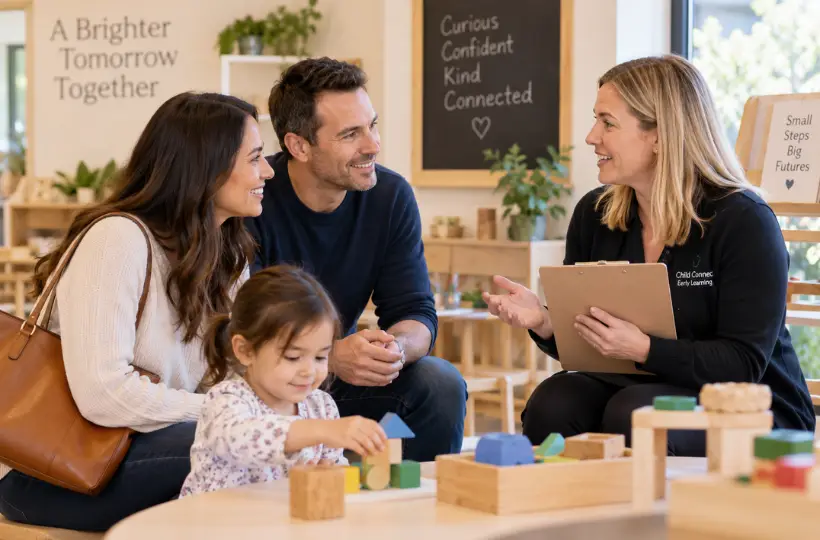
When visiting a centre, ask educators to explain what the Montessori curriculum looks like in their particular program.
Useful questions include:
Ask to see some of the learning materials as well.
More importantly, observe the children and educators during your tour.
The quality of a curriculum isn’t determined by a list of activities alone. How educators interact with children, respond to their needs, and create meaningful learning experiences matters greatly.
If you’re still comparing local preschool options, our complete guide to finding a Montessori preschool near you explains what parents should consider when evaluating curriculum, educators, learning environments, licensing, location, and preschool tours.
Hands-On LearningAt Child Connect Early Learning, children experience a learning environment influenced by Montessori and Reggio Emilia principles alongside purposeful play.
Our approach considers multiple areas of children’s development, including cognitive, social, emotional, physical, communication, and creative growth.
Depending on their program and age, children can experience activities involving areas such as science, music, French, gardening, cooking, robotics, outdoor learning, creative exploration, and age-appropriate academic development.
Parents interested in understanding our approach in greater detail can explore our curriculum and learn how different learning experiences are incorporated into children’s days.
You can also explore our preschool program to learn more about the experiences available for preschool-aged children.
Families interested in seeing the environment firsthand are welcome to learn more about our West Vancouver centre.
The Montessori curriculum provides children with opportunities to learn through practical experiences, sensory exploration, language, mathematics, movement, social interaction, creativity, nature, and increasing independence.
But parents should remember that a curriculum document or educational philosophy doesn’t tell the complete story of a preschool.
The environment matters.
The educators matter.
Relationships matter.
And your individual child’s needs matter.
When comparing Montessori programs, visit the preschool, observe the environment, ask educators how learning happens throughout the day, and consider whether your child will have opportunities to feel safe, connected, curious, capable, and confident.
Understanding what children learn is an important first step. Seeing how those ideas come to life in an actual classroom can help you decide whether the program is right for your family.
Book a Tour to experience the learning environment in person.