Reggio Emilia Approach and Its Wonderful Benefits for Children in North Vancouver
Choosing an early learning program is one of the most important decisions parents make during their child’s early years. Beyond finding a convenient location or suitable schedule, families want an environment where children feel safe, valued, curious, and excited to learn.
For parents exploring preschool and childcare options in North Vancouver, the
Reggio Emilia approach offers an inspiring perspective on early childhood education.
Rather than treating children as passive learners who simply receive information from adults, this educational philosophy recognizes them as capable individuals who can explore ideas, ask meaningful questions, build relationships, and participate actively in their learning.
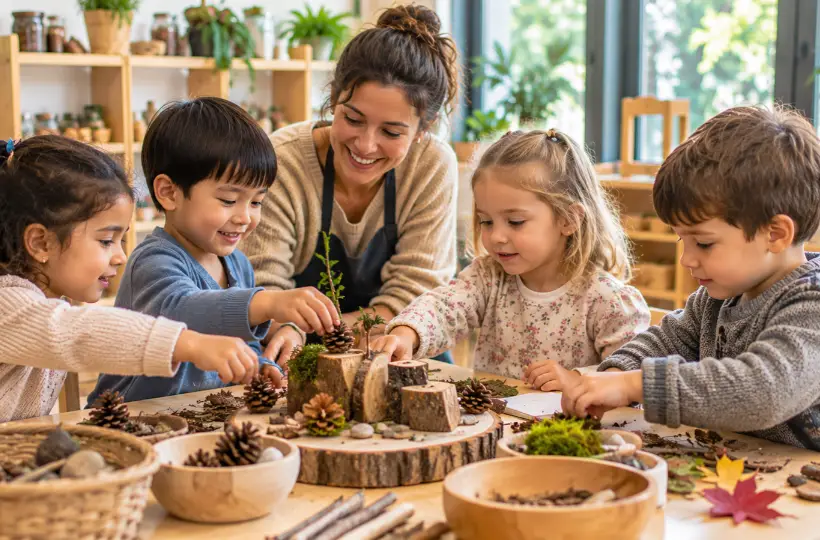
Imagine a group of preschoolers discovering an unusual collection of leaves during outdoor play. Instead of immediately moving on to a predetermined lesson, an educator notices their curiosity. Over the following days, the children might compare leaf shapes, create artwork, investigate trees, build a miniature forest, and share their discoveries through storytelling.
This kind of meaningful exploration reflects the spirit of Reggio Emilia education.
But what exactly is the Reggio Emilia approach? How does it work in an early learning classroom? What are its potential benefits, and how can parents determine whether a Reggio Emilia-inspired environment is suitable for their child?
This guide explores the philosophy, its principles, classroom practices, and the important considerations for families choosing early childhood education in North Vancouver.
What Is the Reggio Emilia Approach?
The
Reggio Emilia approach is an educational philosophy that originated in the city of Reggio Emilia, Italy, following the Second World War.
The approach developed through the efforts of local families, educators, and communities who wanted to create a more thoughtful and participatory form of early childhood education. Italian educator Loris Malaguzzi became an influential figure in its development.
At its heart, the philosophy views children as capable, curious, and active participants in their own learning.
Instead of relying exclusively on predetermined lessons, educators observe children’s interests and use those observations to develop meaningful learning experiences.
For example, if children become fascinated by rain, an educator might encourage them to investigate where water comes from, explore puddles, create rain-inspired artwork, and discuss how weather changes their surroundings.
The educator still has an important role. However, rather than controlling every learning experience, the educator supports children’s thinking through questions, materials, conversations, and carefully planned opportunities for exploration.
Is Reggio Emilia a Curriculum or an Educational Philosophy?
Reggio Emilia is better understood as an educational approach than as a fixed curriculum.
A conventional curriculum may specify particular topics or activities to complete during a given week. In a Reggio Emilia-inspired environment, learning experiences often develop from children’s interests, questions, and observations.
This does not mean learning happens without planning.
Educators carefully document children’s activities, identify emerging interests, and create opportunities that encourage deeper investigation.
The approach provides a framework for meaningful learning while allowing flexibility in how experiences unfold.
What Ages Is the Reggio Emilia Approach Suitable For?
The Reggio Emilia approach was developed primarily for infant-toddler centres and preschools.
Its principles can be adapted to different developmental stages.
For infants, educators may emphasize secure relationships, sensory exploration, movement, and responsive interactions.
For toddlers, experiences may involve hands-on discovery, language development, imaginative play, and opportunities to make simple choices.
Preschool-aged children may participate in more complex projects involving art, storytelling, construction, collaboration, and problem-solving.
The specific activities should always reflect each child’s developmental needs, abilities, and interests.
The Core Principles of the Reggio Emilia Approach
Although Reggio Emilia-inspired programs may differ in their daily practices, several important principles guide the philosophy.
Understanding these principles can help North Vancouver parents recognize what meaningful child-centred learning looks like.
1. Children Are Capable and Curious Learners
One of the most important ideas behind the Reggio Emilia approach is that children are naturally curious and capable of developing their own understanding of the world.
Children are encouraged to ask questions, experiment with materials, express opinions, and explore different possibilities.
For example, when children build a bridge using wooden blocks, an educator might ask:
- What could make the bridge stronger?
- Why do you think it fell?
- What might happen if we use different materials?
These questions encourage children to investigate their ideas rather than simply receive the correct answer.
The goal is not to expect children to solve every problem independently. Instead, educators provide support that helps children develop confidence in their thinking.
2. Learning Happens Through Relationships
Relationships are central to Reggio Emilia education.
Children learn through interactions with educators, classmates, families, and the surrounding community.
When children work together on a project, they encounter different perspectives and learn to communicate their own ideas.
For example, two children building a pretend grocery store may need to decide where to place shelves, what items to include, and how customers will use the space.
Through these interactions, they practise communication, cooperation, negotiation, and shared decision-making.
Educators help children navigate disagreements respectfully and encourage them to listen to one another.
These experiences can support the development of important social and emotional skills.
3. The Environment Is the Third Teacher
In Reggio Emilia education, the physical learning environment plays an important role.
The expression
“the environment as the third teacher” reflects the idea that children learn not only from adults and peers but also from the spaces and materials surrounding them.
A thoughtfully organized classroom can invite exploration, creativity, and independence.
For example, a low shelf containing natural materials, magnifying glasses, paper, and drawing tools may encourage children to investigate objects without waiting for an adult to direct every step.
Classrooms often include flexible spaces for individual exploration, small-group collaboration, artistic expression, and quiet reflection.
The environment is designed to make children’s learning visible and accessible.
4. Children Have Many Ways to Express Themselves
The Reggio Emilia philosophy is closely associated with the concept of the
hundred languages of children.
This idea recognizes that children communicate and express their understanding through many forms, not only spoken or written language.
A child might explore an idea through drawing, painting, movement, music, construction, dramatic play, or storytelling.
For example, after observing a bird outside, one child may draw it, another may build a nest using natural materials, and another may imitate its movements.
Each expression offers insight into how the child understands the experience.
Educators value these different forms of communication and create opportunities for children to express themselves in ways that feel meaningful.
5. Families Are Important Partners in Learning
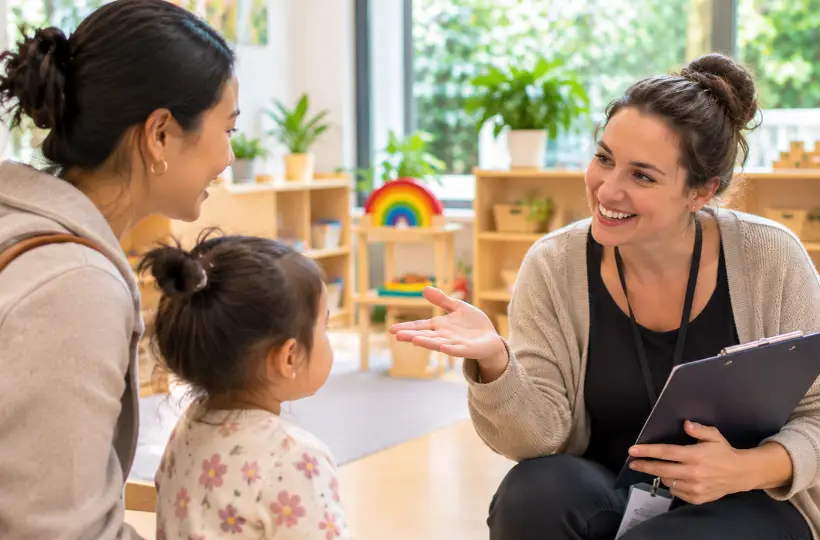
The Reggio Emilia approach recognizes families as essential participants in children’s education.
Parents bring valuable knowledge about their child’s interests, routines, experiences, culture, and development.
Educators can use this understanding to create more meaningful learning experiences.
For example, a parent might mention that their child has become fascinated by buses during the daily commute. An educator could build on this interest by introducing toy vehicles, maps, construction materials, or discussions about transportation.
Regular communication also helps families understand what their children are exploring at the centre.
For parents in North Vancouver, this partnership can create continuity between learning experiences at home and in childcare.
How Reggio Emilia Encourages Creativity and Independence
One of the most appealing aspects of the Reggio Emilia approach is its emphasis on meaningful exploration.
Rather than requiring every child to produce an identical result, educators encourage children to experiment, make choices, and develop their own ideas.
Encouraging Creativity Through Open-Ended Experiences
Consider an art activity involving paint, paper, and natural materials.
In a highly structured activity, children might be instructed to reproduce a specific picture.
In a Reggio Emilia-inspired activity, educators may invite children to explore how different materials create shapes, patterns, and textures.
One child might paint with a brush, another might use a leaf, and another might experiment with mixing colours.
The focus is on exploration and expression rather than producing identical artwork.
This approach creates opportunities for imagination and experimentation.
Supporting Independence Through Meaningful Choices
Independence develops gradually as children gain experience making decisions and taking responsibility for manageable tasks.
In an early learning classroom, children may choose between available materials, participate in organizing the learning environment, or contribute ideas for group activities.
Educators provide guidance while allowing children appropriate opportunities to make decisions.
For example, children planning a pretend restaurant might decide what food to serve, how to arrange the tables, and which materials to use.
These experiences can help children develop initiative, confidence, and a sense of responsibility.
Learning Through Trial and Error
Mistakes are a natural part of learning.
When a child builds a tall block tower that collapses, the educator does not necessarily need to rebuild it immediately.
Instead, the educator might ask what the child noticed and encourage another attempt.
The child may experiment with wider blocks, a different base, or a new arrangement.
Through this process, children practise persistence and problem-solving.
Importantly, educators remain attentive to children’s frustration levels and provide support when needed.
The Role of Educators in Reggio Emilia Learning
A common misunderstanding is that child-led learning means educators simply allow children to play without guidance.
In reality, effective Reggio Emilia-inspired education requires careful observation, planning, and professional judgment.
Educators act as researchers, facilitators, collaborators, and guides.
Observing Children’s Interests
Educators pay close attention to children’s conversations, activities, questions, and interactions.
These observations help identify interests that may become meaningful learning opportunities.
For example, several children may repeatedly create roads using wooden blocks.
An educator might recognize an emerging interest in transportation and introduce maps, different vehicles, building materials, and photographs of local streets.
The activity develops from children’s curiosity while the educator intentionally expands the learning possibilities.
Asking Thoughtful Questions
Educators use open-ended questions to encourage deeper thinking.
Instead of asking only questions with one correct answer, they may ask:
- What do you notice?
- How could we find out?
- What else might work?
- Why do you think that happened?
- How could we show someone else what we discovered?
These conversations encourage children to explain their thinking and consider new possibilities.
Documenting Children’s Learning
Documentation is another important feature of the Reggio Emilia approach.
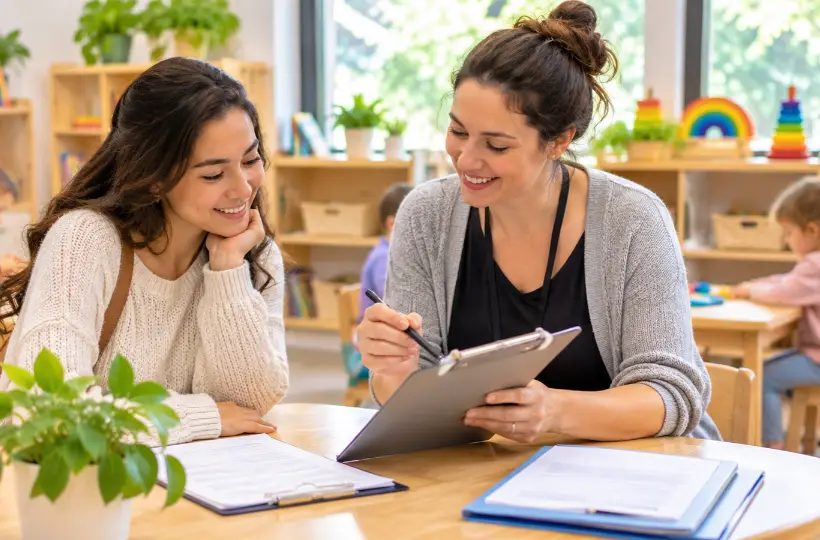
Educators may record children’s observations, conversations, artwork, photographs, and project developments.
This documentation helps make learning visible.
For example, a display about a gardening project might show photographs of children planting seeds, their drawings of growing plants, and comments about what they observed.
Parents can see not only the finished result but also how their children’s thinking developed.
Documentation also helps educators reflect on learning experiences and plan appropriate next steps.
What a Reggio Emilia-Inspired Classroom Looks Like
A Reggio Emilia-inspired classroom often feels welcoming, organized, and full of opportunities for discovery.
However, no single classroom layout automatically makes a program Reggio Emilia-inspired.
What matters is how educators use the environment to support children’s learning.
Natural Materials and Open-Ended Resources
Classrooms may include materials such as wooden blocks, stones, shells, fabric, clay, recycled objects, and drawing supplies.
These resources can be used in different ways, allowing children to create their own experiences.
A collection of wooden blocks might become a bridge, a house, a train station, or an imaginary city.
Open-ended materials encourage children to explore possibilities without being restricted to one intended outcome.
Spaces for Collaboration and Individual Exploration
A thoughtfully designed classroom provides opportunities for different kinds of learning.
Some children may enjoy working with others on a shared project, while others may prefer quieter activities.
Learning spaces can support both experiences.
Small tables, accessible shelves, reading corners, construction areas, and creative stations may help children engage comfortably.
The arrangement should also consider children’s safety, developmental needs, and accessibility.
Displays That Celebrate Children’s Thinking
In Reggio Emilia-inspired environments, classroom displays often feature children’s actual work and learning processes.
Instead of relying entirely on commercially produced decorations, educators may display children’s drawings, photographs, project notes, and recorded conversations.
These displays communicate that children’s ideas are valuable.
They can also encourage children to revisit previous experiences and continue developing their thinking.
Bringing the Outdoors Into Learning
Nature can provide rich opportunities for observation and discovery.
Children might explore leaves, investigate insects, observe changing weather, or create artwork inspired by natural objects.
For families in North Vancouver, the surrounding natural environment offers particularly relevant opportunities to connect early learning with forests, gardens, mountains, and seasonal changes.
Outdoor experiences should be adapted to the children’s ages, abilities, weather conditions, and appropriate safety practices.
Reggio Emilia Activities That Support Meaningful Learning
The Reggio Emilia approach can inspire a wide range of activities.
The most meaningful experiences often begin with children’s interests rather than a fixed list of projects.
Nature Investigation
Children might collect fallen leaves, compare their shapes, create patterns, or observe how colours change throughout the seasons.
Educators can introduce magnifying glasses, drawing materials, and age-appropriate questions to encourage further exploration.
Collaborative Construction
A group of children might use blocks, cardboard, fabric, and recycled materials to create a neighbourhood.
As the project develops, children can discuss where buildings should go, how roads connect, and what their community needs.
This type of activity provides opportunities for cooperation, communication, and problem-solving.
Creative Storytelling
Children may use puppets, drawings, loose parts, or dramatic play to tell stories.
Educators can encourage them to describe characters, imagine events, and build on one another’s ideas.
Storytelling can support language development and creative expression.
Light and Shadow Exploration
Using safe light sources, translucent materials, and everyday objects, children can explore shadows, shapes, and changing patterns.
Educators may invite children to predict what will happen when an object moves closer to or farther from a light source.
These experiences introduce early scientific thinking through hands-on discovery.
For more practical examples, parents can explore our upcoming guide to
Reggio Emilia activities for preschoolers.
Reggio Emilia and Montessori: Understanding the Differences
Parents researching early childhood education in North Vancouver often encounter both Reggio Emilia and Montessori.
Although the two approaches share an appreciation for children’s independence and active participation, they differ in several important ways.
Montessori education is generally associated with a carefully prepared environment, specialized learning materials, and opportunities for children to work independently at their own pace.
Reggio Emilia education places particular emphasis on relationships, collaborative projects, creative expression, and learning experiences that emerge from children’s interests.
Both approaches can support meaningful early childhood learning when implemented thoughtfully.
Neither philosophy should automatically be considered the best choice for every child.
The quality of educator-child relationships, learning experiences, safety practices, and overall program environment is also important.
For a more detailed explanation, read our guide to
Montessori vs Reggio Emilia and Other Educational Philosophies.
Parents interested specifically in Montessori learning can also explore
What Is a Montessori Daycare and How Does It Work?.
Is the Reggio Emilia Approach Right for Your Child?
The Reggio Emilia approach may appeal to families who value creativity, exploration, collaboration, and meaningful relationships in early childhood education.
However, choosing an appropriate childcare program involves more than selecting an educational philosophy.
Every child has unique needs, interests, and developmental characteristics.
Some children enjoy participating in collaborative projects, while others need additional time and support before becoming comfortable in group settings.
Some children communicate confidently through language, while others express themselves more readily through movement, art, or play.
A responsive educator should recognize these differences and adapt experiences accordingly.
Consider Your Child’s Interests and Personality
Think about the activities your child naturally enjoys.
Do they frequently ask questions about their surroundings?
Do they enjoy building, drawing, storytelling, or exploring nature?
Are they interested in working with other children?
These observations can help you understand what kinds of learning experiences may be engaging.
However, a child does not need to display a particular personality or learning style to benefit from a thoughtfully designed early childhood program.
Look Beyond the Educational Label
A childcare centre may describe itself as Montessori-inspired, Reggio Emilia-inspired, play-based, or child-centred.
These labels can provide useful information, but parents should also examine how the program operates in practice.
Ask educators how they respond to children’s interests, support emotional development, communicate with families, and balance exploration with daily routines.
Observing the classroom environment and educator-child interactions can reveal more than the program description alone.
Consider Practical Family Needs
The right program should also work for your family.
Important considerations include operating hours, location, age-group availability, fees, communication practices, and daily routines.
For North Vancouver families, commuting time and proximity to home or work may influence the decision.
A strong educational philosophy is valuable, but the overall childcare experience should also be practical, safe, and supportive.
Exploring Reggio Emilia-Inspired Early Learning in North Vancouver
North Vancouver offers families a distinctive setting for early childhood learning.
With access to natural environments, community spaces, and neighbourhood amenities, children can encounter meaningful opportunities for observation, exploration, and connection.
The Reggio Emilia approach can be particularly relevant to experiences involving nature, community, creativity, and collaboration.
However, parents should not assume that every preschool or childcare centre follows the same educational model.
When researching programs, it is helpful to ask how each centre incorporates child-led exploration and educator-guided learning.
What Should Parents Look for During a Preschool Visit?
When visiting an early learning centre in North Vancouver, observe how children and educators interact.
Are educators attentive to children’s questions and ideas?
Do children have access to age-appropriate materials that encourage exploration?
Are learning spaces welcoming, organized, and suitable for the age group?
Can educators explain how activities connect to children’s interests and developmental needs?
Also pay attention to how the centre communicates with families.
Clear information about routines, safety procedures, daily activities, and enrollment expectations can help parents make confident decisions.
Our
Important Questions to Ask a Daycare guide offers additional questions to consider during a childcare tour.
How Important Is the Learning Environment?
The physical environment is important, but it is only one part of a high-quality childcare experience.
Beautiful classrooms and attractive materials do not replace responsive educators, appropriate supervision, safe practices, and positive relationships.
Parents should consider the overall program rather than focusing exclusively on classroom appearance.
How Can Parents Evaluate a Program’s Educational Approach?
Ask the childcare team to describe a recent learning project.
For example, an educator might explain how children’s interest in insects developed into outdoor observations, drawings, stories, and collaborative activities.
This type of example can reveal how the program responds to children’s curiosity.
Parents can also ask how educators document learning and share progress with families.
These conversations can help distinguish a meaningful educational approach from a description used mainly for marketing.
How Parents Can Support Reggio Emilia Principles at Home
Families do not need a specially designed classroom to encourage curiosity and exploration.
Many Reggio Emilia principles can be incorporated into ordinary family activities.
Follow Your Child’s Questions
When your child asks a question, consider exploring the answer together.
For example, if your child wonders why leaves change colour, you might observe trees during a walk, collect fallen leaves, and discuss what changes over time.
The goal is not to deliver a complicated scientific explanation.
Instead, encourage observation, conversation, and curiosity.
Offer Open-Ended Materials
Simple materials can inspire meaningful play.
Cardboard boxes, paper, crayons, building blocks, fabric, and age-appropriate natural objects can support creativity.
Rather than demonstrating exactly what to make, invite your child to explore different possibilities.
Encourage Conversation and Reflection
Ask your child about their experiences.
Questions such as “What did you notice?” or “How did you make that?” can encourage children to describe their thinking.
Listen carefully and show interest in their explanations.
These conversations help children recognize that their ideas matter.
Make Time for Outdoor Discovery
North Vancouver families can incorporate nature exploration into everyday routines.
A neighbourhood walk may provide opportunities to notice birds, examine different leaves, observe clouds, or listen to the sounds of the environment.
Simple observations can become starting points for drawings, stories, and further questions at home.
Frequently Asked Questions About the Reggio Emilia Approach
What is the main goal of the Reggio Emilia approach?
The Reggio Emilia approach aims to support children’s learning through exploration, relationships, creativity, and active participation. It recognizes children as capable individuals who develop understanding through meaningful experiences.
Is Reggio Emilia better than Montessori?
Neither approach is universally better. Montessori and Reggio Emilia emphasize different educational practices, and the right choice depends on the child’s needs, the quality of the program, and the family’s preferences.
Does the Reggio Emilia approach include structured learning?
Yes. Although learning experiences often emerge from children’s interests, educators intentionally observe, plan, document, and extend activities. Child-led learning does not mean the absence of educational structure.
Can toddlers benefit from Reggio Emilia education?
Yes. Reggio Emilia-inspired principles can be adapted for toddlers through sensory exploration, responsive relationships, imaginative play, movement, and age-appropriate opportunities to make choices.
What does the hundred languages of children mean?
The hundred languages concept recognizes that children express ideas through many forms of communication, including art, movement, construction, music, dramatic play, and spoken language.
How do I find a Reggio Emilia-inspired preschool in North Vancouver?
Start by researching local childcare programs and reviewing their educational philosophies. Contact centres directly to ask how they support child-led learning, creative exploration, and collaboration. When possible, arrange a visit to observe the environment and speak with educators.
Is Reggio Emilia suitable for children who are shy or reserved?
A responsive Reggio Emilia-inspired environment can accommodate different personalities and communication styles. Educators should provide opportunities for both individual exploration and group participation without forcing children into uncomfortable interactions.
What should I ask about Reggio Emilia during a childcare tour?
Ask how educators identify children’s interests, plan learning projects, document progress, involve families, and support different developmental needs. Requesting an example of a recent classroom project can be particularly helpful.
Discover Inspiring Early Learning at Child Connect North Vancouver
At Child Connect Early Learning, we believe young children deserve opportunities to feel secure, develop meaningful relationships, explore their interests, and grow with confidence.
Our educational philosophy draws on Montessori and Reggio Emilia principles alongside purposeful, play-based learning experiences.
At our operating North Vancouver location, families can explore infant, toddler, and preschool programs designed to support children’s early development in a welcoming environment.
Whether your child is beginning their first childcare experience or preparing for preschool, choosing a centre that values curiosity, creativity, and positive relationships can help establish a strong foundation for future learning.
Visit
Child Connect North Vancouver to learn more about our programs, contact our team, and inquire about enrollment availability.
Give your child a positive start to their early learning journey with Child Connect North Vancouver.