

Call Us
want to understand the educational philosophy that shapes how children spend their day, interact with educators, explore their environment, and develop new skills.
Two approaches parents frequently encounter are Montessori and Reggio Emilia. Although both respect children as capable learners and place importance on the learning environment, they have meaningful differences.
The Montessori vs Reggio comparison becomes especially useful when parents are trying to understand whether their child may benefit more from independent, hands-on learning or from a more collaborative, project- and inquiry-oriented environment.
Parents may also encounter other daycare philosophies, including Waldorf, also known as Steiner education, as well as programs described more broadly as play-based.
The greatest gifts we can give our children are the roots of responsibility and the wings of independence.
Maria Montessori Tweet
There isn’t one philosophy that is automatically best for every child. Understanding the differences can instead help parents ask better questions when comparing daycare and preschool programs.
Montessori education was developed by Dr. Maria Montessori and is based on children’s developmental needs, independence, purposeful activity, and interaction with a carefully prepared environment.
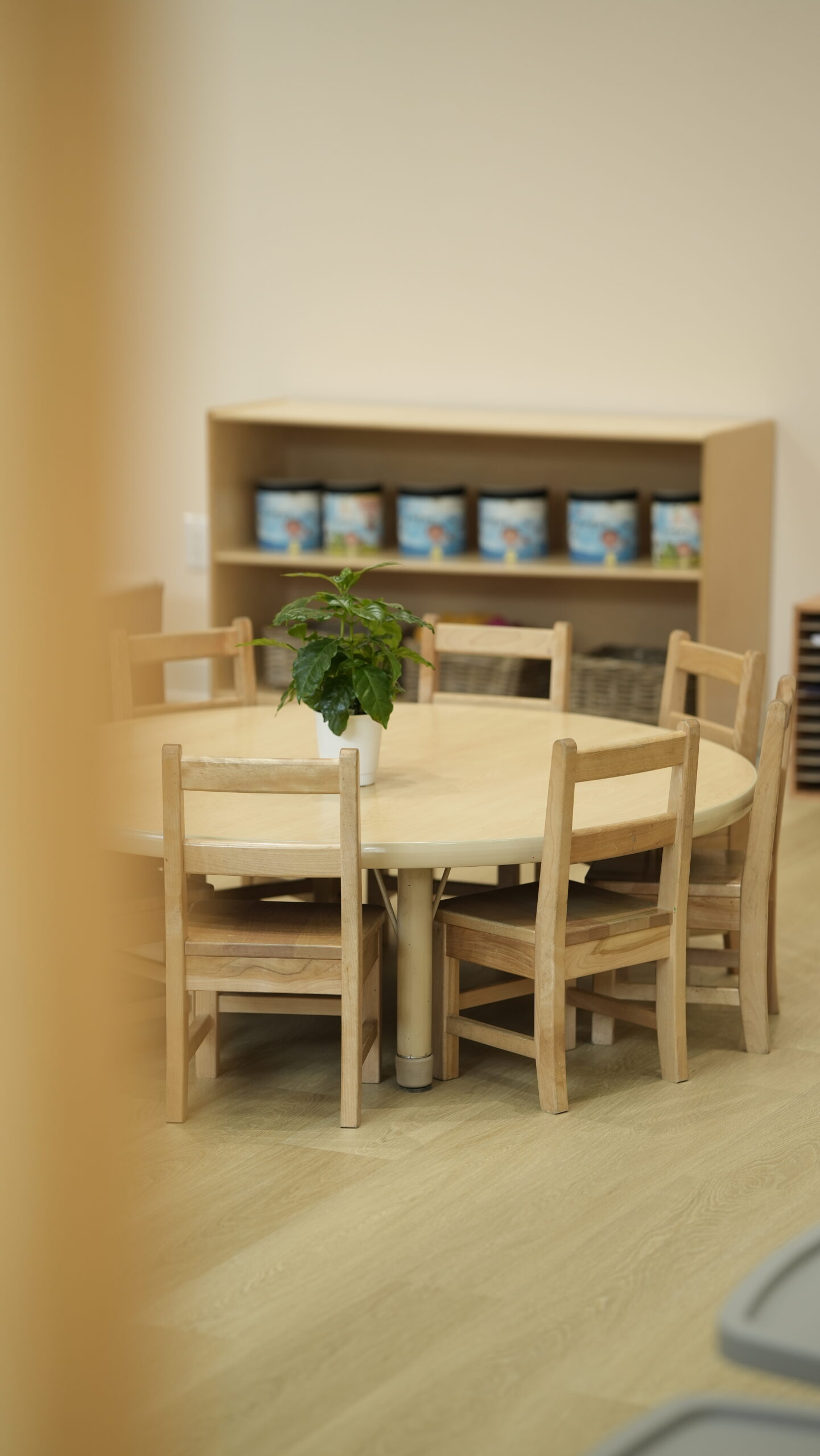
A Montessori environment is intentionally organized so children can access developmentally appropriate activities and gradually become more independent.
For children ages three to six, the Association Montessori Internationale describes Montessori learning as including real-life activities that support independence, concrete sensory experiences, and opportunities for children to follow their interests, choose activities, concentrate, and work at their own pace. Montessori activities traditionally cover areas including Practical Life, Sensorial development, language, mathematics, geography, science, music, and the arts.
Children might spend time:
The educator does not disappear from this process. Instead, educators observe children, introduce appropriate activities and materials, and provide guidance while allowing children opportunities to practise independently.
If you want a deeper explanation of the learning areas involved, read what children learn in a Montessori curriculum. For younger children in childcare settings, you can also learn more about how Montessori daycare works.
The Reggio Emilia approach originated in the Italian city of Reggio Emilia and developed through its municipal infant-toddler centres and preschools, with Loris Malaguzzi playing a central role in its development.
Like Montessori, Reggio Emilia doesn’t view children as passive recipients of information.
Children are considered active participants in learning.
One of its best-known ideas is the hundred languages of children, described by Reggio Children as the many ways children can think, investigate, communicate, create, and express their understanding.
These forms of expression can include experiences involving:
Relationships are particularly important.
Children learn in interaction with other children, educators, families, materials, spaces, and their broader environment. Reggio Emilia also places considerable emphasis on collaboration, documentation of children’s learning processes, family participation, and the environment itself as an educator.
Rather than following only a predetermined sequence of activities, educators can observe children’s questions and interests and help those interests develop into deeper investigations.
For example, if several children become fascinated by rain, educators might help them explore where water goes, make drawings, collect rainwater, discuss weather, build something related to water, read books, or document the children’s questions and discoveries.
Learning can therefore develop from children’s curiosity.
The most important part of this article is understanding the Montessori vs Reggio comparison.
The two approaches share some important principles.
Both recognize children’s capabilities. Both place considerable importance on the environment. Both value exploration and meaningful experiences. And neither approach requires educators to spend the entire day standing in front of a group delivering conventional lessons.
But Montessori and Reggio Emilia are not the same philosophy.
One of the biggest differences is how learning experiences are organized.
Montessori typically provides a carefully prepared environment containing developmentally appropriate activities and materials. Children have opportunities to select activities, work with them, repeat them, and gradually develop greater independence.
Reggio Emilia is generally more emergent and relational. Children’s questions, conversations, relationships, and interests can contribute to the direction of projects and investigations. A simplified comparison looks like this:
| Area | Montessori | Reggio Emilia |
|---|---|---|
| Main Emphasis | Independence and development | Relationships and inquiry |
| Learning Style | Hands-on and self-directed | Inquiry and project-oriented |
| Curriculum | More prepared and sequenced | More emergent |
| Materials | Specific learning materials | Often open-ended materials |
| Educator | Observer and guide | Collaborator and researcher |
| Child Choice | Strong emphasis | Strong influence through interests |
| Collaboration | Possible and supported | Particularly emphasized |
| Environment | Prepared environment | Environment as educator |
| Documentation | Can be used | Central to the approach |
| Creativity | Integrated | Strong form of expression |
These are broad distinctions. Individual childcare centres may adapt these ideas differently.
Another important difference becomes visible when you look at what educators do.
In Montessori, educators carefully observe children and introduce materials or activities when appropriate. After demonstrating an activity, the educator generally gives the child room to explore and practise it.
This supports independence.
For example, an educator may demonstrate how to pour water from one container into another. Rather than continuously directing the child, the educator can then allow the child to practise.
In Reggio Emilia, educators also observe carefully, but there is a particularly strong emphasis on learning as something constructed through relationships, research, exchange, and discussion. Reggio Children describes children as active protagonists and learning as both individual and group-based.
Imagine children discover an unusual insect outside.
A Reggio-inspired educator might ask questions about what the children notice and what they want to know.
Those questions could develop into a larger investigation involving drawing, photography, books, models, conversations, nature observations, or collaborative work.
The educator isn’t simply delivering an insect lesson. The educator is helping children investigate their own questions more deeply.
The environment matters greatly in both philosophies.
In Montessori, the prepared environment is deliberately designed around children’s developmental characteristics and interests. AMI describes features such as accessible furniture, different workspaces, specific learning materials, freedom of appropriate activity choice, and opportunities for hands-on, self-directed learning.
Order is important because the environment itself supports independence.
A child should increasingly be able to locate an appropriate activity, use it and return it to its proper place.
Reggio Emilia also places considerable importance on physical space, but conceptualizes the environment somewhat differently.
Reggio Children describes interior and exterior spaces as interconnected places for living together and research. The environment evolves in relation to projects and learning experiences and is itself considered part of the educational process.
A Reggio-inspired environment may therefore include areas for collaborative projects, displays documenting children’s thinking, creative materials, natural objects, flexible workspaces, and children’s ongoing investigations.
Both environments can be carefully designed and beautiful.
Their purposes and organization, however, reflect somewhat different educational ideas.
Creativity provides another useful comparison.
Montessori education includes opportunities involving areas such as art, music, science and language, alongside practical life, sensorial and mathematical activities.
Reggio Emilia places particularly strong emphasis on the many ways children express ideas.
This is connected to the concept of the hundred languages.
A child might investigate the same idea through drawing, building, movement, conversation, sculpture, dramatic play, natural materials or another form of expression.
The important point is not that Reggio is “creative” while Montessori is “not creative.”
That would be an inaccurate oversimplification.
Rather, creative expression occupies a particularly central role in the Reggio Emilia philosophy and in how children’s thinking and learning processes are made visible.
Montessori is particularly associated with independence.
The prepared environment gives children opportunities to choose appropriate activities, work at their own pace, care for materials, practise practical skills, and gradually take more responsibility for themselves and their environment.
This does not mean Montessori children always work alone.
Montessori environments can include individual, collaborative, and peer-to-peer learning.
Reggio Emilia, however, gives relationships and group knowledge-building a particularly prominent role. Learning may develop through conversations, shared questions, group investigations, and collaboration between children and educators.
So the difference should not be described as:
Montessori = individual
Reggio = group
That is too simplistic.
A more accurate distinction is that Montessori puts particularly strong emphasis on developing individual independence and self-directed activity, while Reggio Emilia places particularly strong emphasis on relationships, participation, collaborative inquiry, and constructing knowledge with others.
When researching daycare philosophies, parents may also encounter Waldorf and Steiner education.
An important clarification is that Waldorf and Steiner should not be treated as two separate approaches.
Waldorf education developed from the educational philosophy of Rudolf Steiner, which is why the terms Waldorf education and Steiner education may both appear when parents research educational options.
For this article, we therefore discuss them together rather than creating repetitive Waldorf and Steiner sections.
In early childhood, Waldorf/Steiner education is commonly associated with areas such as:
This creates some meaningful differences when comparing Montessori vs Waldorf.
Montessori environments tend to emphasize concrete real-world experiences, purposeful activities, specific learning materials, independence, and children’s ability to choose from prepared activities.
Waldorf/Steiner early childhood environments tend to give imagination, free play, storytelling, artistic experiences, rhythm, and natural materials a more prominent role.
This doesn’t mean one is better.
It means parents should consider what kind of environment fits their child’s needs and their family’s educational preferences.
Once Waldorf and Steiner are correctly treated as one philosophy, parents can compare the three main approaches more easily.
| Area | Montessori | Reggio Emilia | Waldorf/Steiner |
|---|---|---|---|
| Main Emphasis | Independence | Inquiry & relationships | Imagination & rhythm |
| Learning | Hands-on and self-directed | Project and inquiry-oriented | Play and experience-oriented |
| Materials | Specific Montessori materials | Open-ended materials | Natural and simple materials |
| Educator | Guide and observer | Collaborator and researcher | Model and storyteller |
| Environment | Prepared and ordered | Flexible and evolving | Warm and home-like |
| Child Interests | Guide activity choices | Can shape investigations | Play within daily rhythm |
| Collaboration | Present | Strong emphasis | Shared experiences |
| Creativity | Integrated | Strong expression focus | Strong arts and imagination focus |
| Practical Activities | Central | Can be incorporated | Important daily experiences |
| Imaginative Play | Different emphasis | Can be important | Particularly central |
This table is intentionally simplified.
Parents should avoid choosing a daycare based only on a philosophy label. How a particular centre interprets and implements its philosophy matters considerably.
Parents may also encounter the term play-based daycare.
Play-based learning is broader than Montessori, Reggio Emilia, or Waldorf and can take many forms.
Children can develop important skills through play, including:
Importantly, a childcare centre doesn’t necessarily have to choose between Montessori, Reggio Emilia, and play.
Some programs are influenced by more than one educational philosophy.
For example, a program might use Montessori-inspired opportunities for independence and practical skills while incorporating Reggio-inspired inquiry, creative expression, collaboration, and purposeful play.
For parents, this makes it particularly important to ask how the philosophy appears in children’s actual day, rather than focusing entirely on terminology.
There is no universal answer.
Instead of asking which philosophy is objectively best, consider which environment may fit your child’s personality, interests, developmental stage, and learning preferences.
For example, consider whether your child:
Even then, avoid assuming that a particular philosophy automatically guarantees a particular experience.
Two Montessori-inspired daycares can feel different from one another.
The same is true of two Reggio-inspired programs.
The educators, environment, relationships, daily routines, leadership, and interpretation of the philosophy all matter.
Educational philosophy is only one part of early childhood education in B.C.
The B.C. Early Learning Framework provides broader guidance for early learning and applies to children from birth to eight years. It emphasizes relationships among children, families, communities, educators, environments, materials, and ideas rather than prescribing Montessori, Reggio Emilia, Waldorf, or another particular philosophy.
This means parents can encounter centres influenced by different daycare philosophies while still operating within the broader B.C. early learning context.
When comparing programs, parents can therefore ask two different questions:
What philosophy influences this daycare?
and, more importantly:
How does that philosophy affect my child’s everyday experience?
Understanding Montessori vs Reggio can help parents compare educational ideas, but choosing a daycare should involve much more than deciding which philosophy sounds best.
Consider:
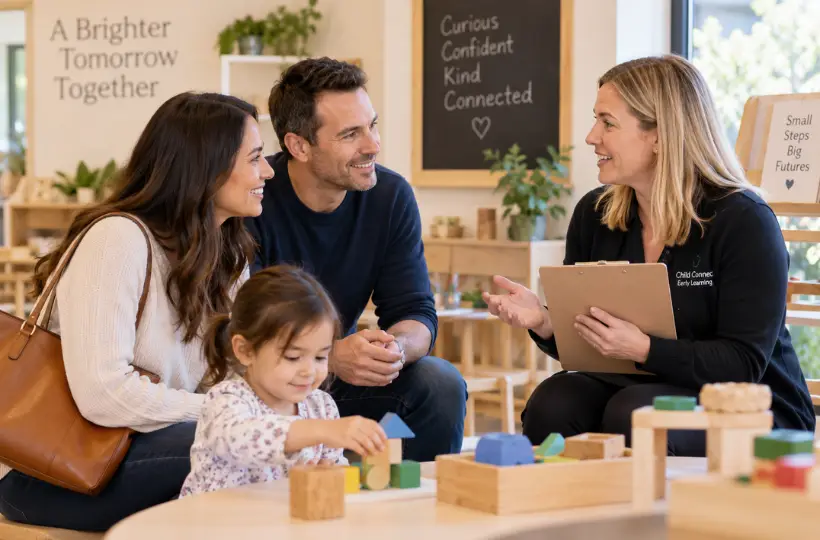
During a tour, observe how educators communicate with children.
Look at whether children appear comfortable exploring and asking for help.
Ask how the centre incorporates its philosophy into an ordinary day.
If Montessori is one of the approaches you’re considering, our complete guide to finding a Montessori preschool near you explains what parents can look for when evaluating local programs, learning environments, educators, and tours.
At Child Connect Early Learning, our approach draws from Montessori and Reggio Emilia principles alongside purposeful play and other developmentally appropriate learning experiences.
Children can have opportunities to build independence, explore their interests, interact with others, solve problems, communicate ideas, participate in hands-on experiences, create, and discover.
Parents who want to explore specific learning areas can learn more about our curriculum.
You can also explore our preschool program to learn more about the experiences offered to preschool-aged children.
Families looking for childcare on the North Shore can learn more about our West Vancouver centre.
And if you want to see how these ideas translate from educational philosophy into children’s everyday experiences, the best next step is to book a tour and experience the learning environment in person.
The Montessori vs Reggio decision isn’t about identifying a winner.
Montessori tends to place particularly strong emphasis on independence, purposeful hands-on activities, carefully prepared environments, and self-directed learning.
Reggio Emilia places particularly strong emphasis on relationships, inquiry, collaboration, children’s interests, documentation, and multiple forms of expression.
Waldorf, or Steiner education, provides another perspective, with greater emphasis on imaginative play, storytelling, artistic experiences, natural materials, and rhythm.
And many modern childcare environments don’t fit perfectly into a single category.
For parents, the most useful approach is to understand the philosophy and then look beyond the label. Visit the daycare, meet the educators, observe the environment, ask how children spend their day, and consider how well the program fits your child’s individual needs.
The right philosophy matters, but how a daycare brings that philosophy to life matters even more.